Too small for PPWR?
It is the first thing most shop owners say when PPWR comes up, and it is worth answering plainly: there is no general small business exemption. If you put packaging on the EU market, the core duties apply at any size. You register in every country you sell to, you report your packaging by material, and you pay the fees.
What being small does get you is real, but narrower than the word exemption suggests: a shorter report under 10 tonnes, one relief for micro-enterprises, and a handful of countries that set an actual limit. That is the whole list.
Being small changes how much you report, not whether you report.
What stays the same at any size
None of these scale with your revenue. A two-person shop and a national retailer owe the same things here:
- Keeping records of what packaging you use, by material, from today.
- Registering in every EU country you sell to, including your own.
- Reporting and paying the EPR fees in each of those countries.
- An authorised representative in countries where you sell but are not established.
- The material rules, including the limits on PFAS and heavy metals.
Germany is the clearest illustration, and the market most stores reach first. There is no minimum quantity in German law at all. One parcel to a German customer and you register in LUCID before you ship it. We walk through that in PPWR in Germany: LUCID registration.
Being small does not buy you extra time either. By 12 February 2027 every EU country must have its PPWR penalties in place, and national EPR laws already carry their own fines today, including for selling without being registered.
What is genuinely lighter: the 10-tonne report
This is the one EU-wide relief tied to volume, and it is the one most small shops will actually use. Place less than 10 tonnes of packaging on a country’s market in a calendar year and you report a reduced set of information there: your totals by material, once a year, rather than the full data set.
Ten tonnes is a lot. At 200 grams of packaging per order, box and filling included, that is 50,000 orders to a single country in one year. Most small shops stay comfortably under it in every market they sell to.
But read what it is. It is a shorter form, not a missing one. You still register, you still report, and you still pay. The threshold is measured per country, so it is not your total EU volume that decides it.
The one micro-enterprise relief
PPWR uses the EU’s standard definition. You are a micro-enterprise if you have fewer than 10 employees and an annual turnover or balance sheet total of 2 million euros or less. You need both, and it is measured across your whole group, not just your EU sales.
What that earns you is one thing: your supplier can take over the manufacturer duties for your branded packaging. Normally, packaging carrying your brand makes you its manufacturer, so documenting that it meets the requirements falls to you. If you are a micro-enterprise and the supplier who makes it is established in the same country, those duties sit with the supplier instead.
Two things to notice. If your supplier is outside the EU, the relief does not apply. And it is an attribution rule, not an exemption: it moves a duty to someone else rather than deleting it. Your own registering and reporting are untouched.
The countries that do set a limit
Four countries have a threshold that genuinely takes a small seller out of the register. Czechia is the clearest of them.
Czechia leaves you out if you place 300 kg or less of packaging on the Czech market in a calendar year and your annual turnover is CZK 25 million or less. Both conditions, not either. Meet them and the whole block of duties switches off: the entry in the Ministry’s list, the running records, the annual report and the contract with EKO-KOM.
Three hundred kilos sounds generous until you convert it. At roughly 150 g per parcel that is about 2,000 parcels a year to that one country. Forty parcels a week to Czech customers and you are over the line by November.
| Country | Limit | Catch |
|---|---|---|
| Czechia | 300 kg and CZK 25m turnover | Both conditions must be met |
| Netherlands | 50,000 kg | Counted across your VAT group; zero for deposit and single-use plastic |
| Ireland | 10 tonnes and EUR 1m turnover | Both; basic producer duties still apply |
| Malta | 100 kg | Packaging requirements and marking still apply |
Everywhere else you register whatever your volume. Several other countries advertise a limit that only removes the fees or shortens the form while registration and reporting stay, which is where small sellers most often go wrong. The full picture is in packaging EPR thresholds, country by country.
An exemption is a claim, not a status
Nobody issues you a certificate saying you are too small. You assert it, and you carry the burden of proving it.
Czech law is blunt about what happens if you cannot: you must demonstrate on request that you met both conditions, and for any period you cannot evidence, you are treated as having had every one of the duties all along. Poland makes its relief conditional on a declaration filed by a fixed date each year. The Dutch scheme can audit a company that declared itself below the line.
Which leaves small sellers somewhere slightly absurd but entirely consistent: to use an exemption safely you need the same records you would have needed to report. Material by material, country by country, all year. The exemption saves you the filing and the fees. It does not save you the counting.
One change worth watching
There is a proposal that would matter a great deal to small EU sellers. It would suspend the duty to appoint an authorised representative for EU-established micro and small companies, meaning fewer than 50 employees and turnover up to 10 million euros, until the earlier of 1 January 2035 or the Circular Economy Act taking effect.
It is not law. The Parliament’s environment committee produced its draft report in May 2026 and amendments in July, with a plenary vote provisionally scheduled for October 2026, and the Council still has to agree. Until something is published in the Official Journal, the obligation applies in full. It would also only ever remove the representative, never the reporting.
The same goes for the national registers themselves. The implementing act that defines them was due in February 2026, a draft appeared in August, and it has not been adopted. Member states then get 18 months to build their registers, so you keep filing through the systems your countries already run. We cover how that works in PPWR reporting explained.
What a small business should do now
- List the countries you sell to, your own included. That list is your obligation map.
- Work out your packaging weight per country, by material. Under 10 tonnes in a country, your report there gets simpler.
- Check whether you are a micro-enterprise. Fewer than 10 people and 2 million euros or less, across the group.
- Ask your packaging suppliers where they are based and what documentation they provide. It decides what is yours to report.
- Get your packaging data into your store, so the counting happens by itself. Here is how in Shopify.
One genuine shortcut has nothing to do with size: if you buy all your packaging and products from suppliers in your own country and only sell there, your supplier already put that packaging on your market. The moment anything comes from abroad or goes abroad, it is yours to record. See what counts as your packaging.
How GetPPWR fits a small team
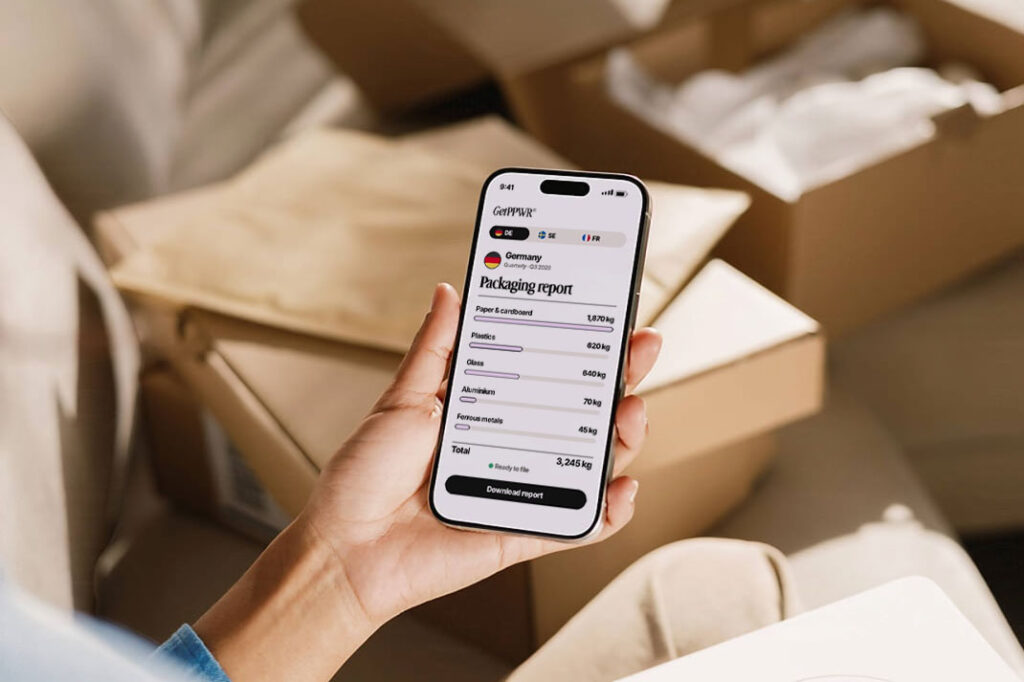
You describe your packaging once with automations. GetPPWR then reads every Shopify order, splits it by material, assigns it to the destination country and totals it across the year, so you can see where you sit against each country’s limit before you cross it rather than after.
That number works in both directions. Over a limit, it is your report, written in the format that country wants. Under a limit, it is the evidence that you were. It covers all 27 EU countries you ship to plus your home EPR report, and shipping packaging bought from a supplier in your own country can be marked so it stays out of that home report. Every plan starts with a 7-day free trial.
New to all this? Start with PPWR explained simply. Not sure which countries you are responsible in? Take the 2-minute quiz.
Sources: Regulation (EU) 2025/40, Articles 44 and 45; Commission Recommendation 2003/361/EC on the definition of micro, small and medium-sized enterprises; Czech Act No. 477/2001 Coll. on Packaging, section 15a; Dutch Besluit beheer verpakkingen; Irish S.I. No. 282/2014; Maltese S.L. 549.43; Commission proposal COM(2025) 982 on the authorised representative and the European Parliament ENVI draft report of May 2026; the European Commission’s PPWR guidance. National rules are moving quickly: check the current position with the relevant register before relying on a limit.
Quick answers about PPWR for small businesses
Is there a PPWR exemption for small businesses?
Not a general one. Small volumes get a shorter report, micro-enterprises get one relief on branded packaging, and four countries set a real limit. Everything else applies at any size.
What counts as a micro-enterprise under PPWR?
Fewer than 10 employees and an annual turnover or balance sheet total of 2 million euros or less. You need both, measured across your whole group.
Do I have to register if I only sell a little?
In almost every country, yes. Under 10 tonnes a year you report less detail, but you still register and still pay. Only Czechia, the Netherlands, Ireland and Malta currently let a small seller out of the register entirely.
Is 10 tonnes a lot of packaging?
Yes. At around 200 grams per order it is roughly 50,000 orders to one country in a year. It is also measured per country, not across the EU, so most small shops are under it everywhere they sell.
Do small businesses need an authorised representative?
Yes, in every EU country where you sell but are not established. A suspension for EU-based micro and small companies has been proposed but not adopted, so the duty applies today.
If I am under a limit, do I still need records?
Yes. An exemption is something you have to prove on request, per material and per country. Without the totals, you cannot show you were under it.
What happens if I wrongly assumed I was too small?
You are treated as having had the full obligations all along, including the registration you never made. Penalties are national and must be in place across the EU by 12 February 2027. See PPWR fines.