
Does PPWR apply to my Shopify store?
If you sell physical products to customers in the EU, yes. Your products come in packaging, and you ship them in more packaging. Both count. Where your store is based doesn’t change that. It changes who does the paperwork. The only exception is a store that buys all its packaging and products from suppliers in its own country and only sells there.
Here’s what to do, in the order that makes sense. New to the acronyms? What is PPWR and PPWR vs EPR cover the basics in a few minutes.
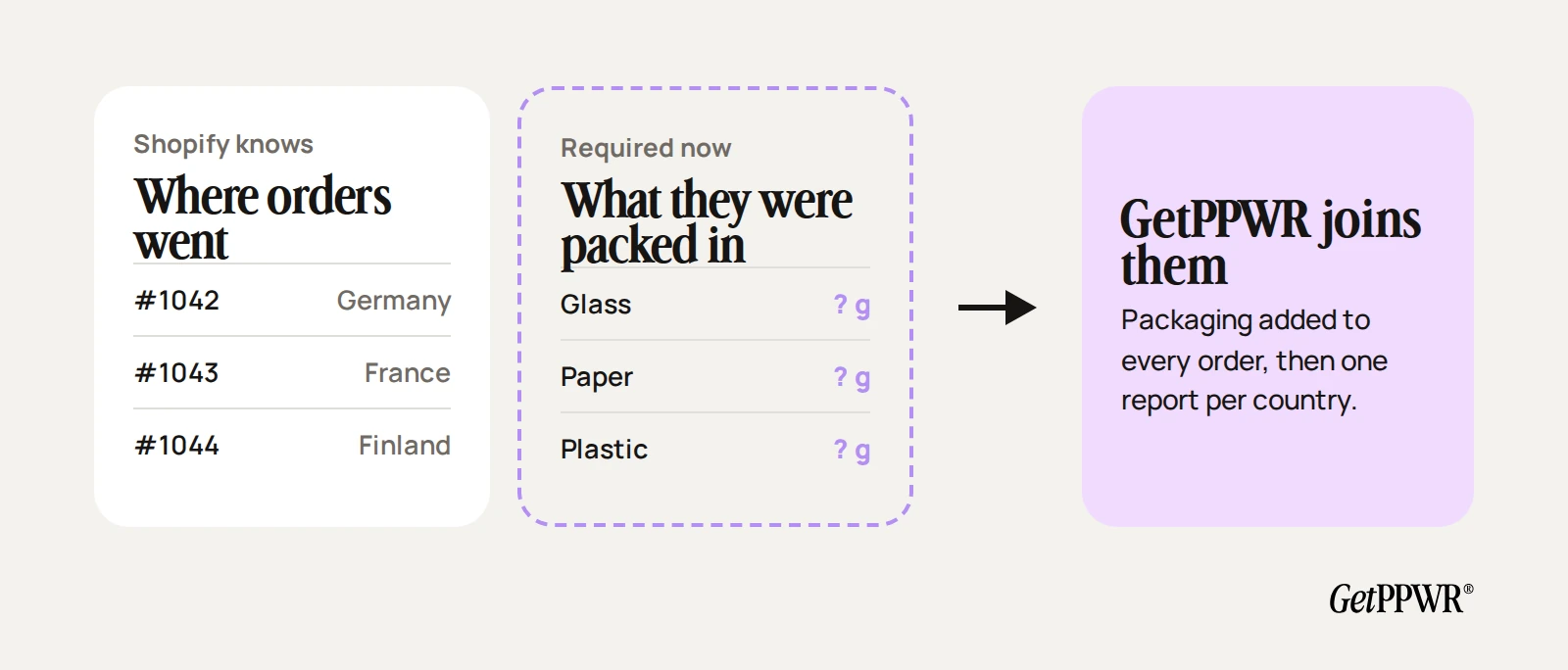
Shopify knows where your orders went. PPWR wants to know what they were packed in. Everything below is about closing that gap.
The 8 steps at a glance
| Step | What you do | Where |
|---|---|---|
| 1 | Work out your role for each packaging | Your packaging list |
| 2 | List the countries you sell in | Shopify sales reports |
| 3 | Register | Each country’s packaging register |
| 4 | Appoint a representative | Countries where you’re not based |
| 5 | Keep your packaging records | Shopify, once per packaging type |
| 6 | Report and pay | Each country, on its own schedule |
| 7 | Collect supplier paperwork | Your packaging suppliers |
| 8 | Keep it running | Every reporting period |
Step 1: Work out your role for each type of packaging
Under PPWR, your role depends on the packaging, not on your company. Go through the packaging you use and ask:
- Is my brand on it, or did I design it? Then you’re likely its manufacturer, and you’ll need paperwork showing it meets the rules.
- Do I import products into the EU? Then you’re the producer of that packaging in the country where you first sell it.
- Do I ship to customers in other EU countries? Then you’re the producer of that packaging in each of those countries.
- Do I pack orders in mailers, boxes and fill? That shipping packaging counts too, everywhere it lands.
Not sure which of these you are? The 2-minute quiz works out your responsibilities from how you sell and ship.
Step 2: List the countries you sell in
Your Shopify sales reports already know this. Look at orders by shipping country for the last year, and include your own country. That list is your to-do list for the next steps.
Step 3: Register in each country
Every EU country has its own packaging register, and under PPWR you’re not allowed to make packaging available in a country until you’re registered there. There’s no single EU registration, so it’s one register per country.
Step 4: Get a representative where you’re not based
In each EU country where your business isn’t established, you need an authorised representative who registers and reports for you. That applies to EU stores selling across borders and to UK or US stores selling into the EU. A pause for small EU businesses has been proposed but isn’t law. Here’s where it stands.
Step 5: Get your packaging data into Shopify
Since 12 August 2026, PPWR requires you to keep records of your packaging. Every report comes down to one question: how much packaging, of which material, went to which country? Shopify knows where your orders went, but not what they were packed in. You don’t have to fill that in product by product. Here’s how to set it up once for your whole catalog.
Step 6: Report and pay, country by country
Each country has its own reporting format and schedule, and the reporting applies now: the EPR rules have applied since 12 August 2026. If you place less than 10 tonnes of packaging in a country in a year, your report there is simpler. Fees are set per country and based on what you reported.
Don’t wait for the fines. By 12 February 2027, every EU country must have its PPWR penalties in place, and national EPR laws already have their own fines today, for example for selling without being registered.
Step 7: Collect paperwork from your suppliers
Ask the companies that make your packaging for their PPWR documentation, including the EU declaration of conformity. If you import packaging or products from outside the EU, you must keep a copy of the declaration for each packaging type and be able to show the technical documentation when asked. It matters just as much for printed or custom packaging, where you may count as the manufacturer yourself. If you’re a micro-enterprise with an EU-based supplier, the supplier can take that on.
Step 8: Keep it running
PPWR isn’t a one-off task. Every order adds to your records, and every country expects its report on its own schedule. Update your packaging data when a supplier or a box changes, and file on time, period after period.
Where does GetPPWR come in?
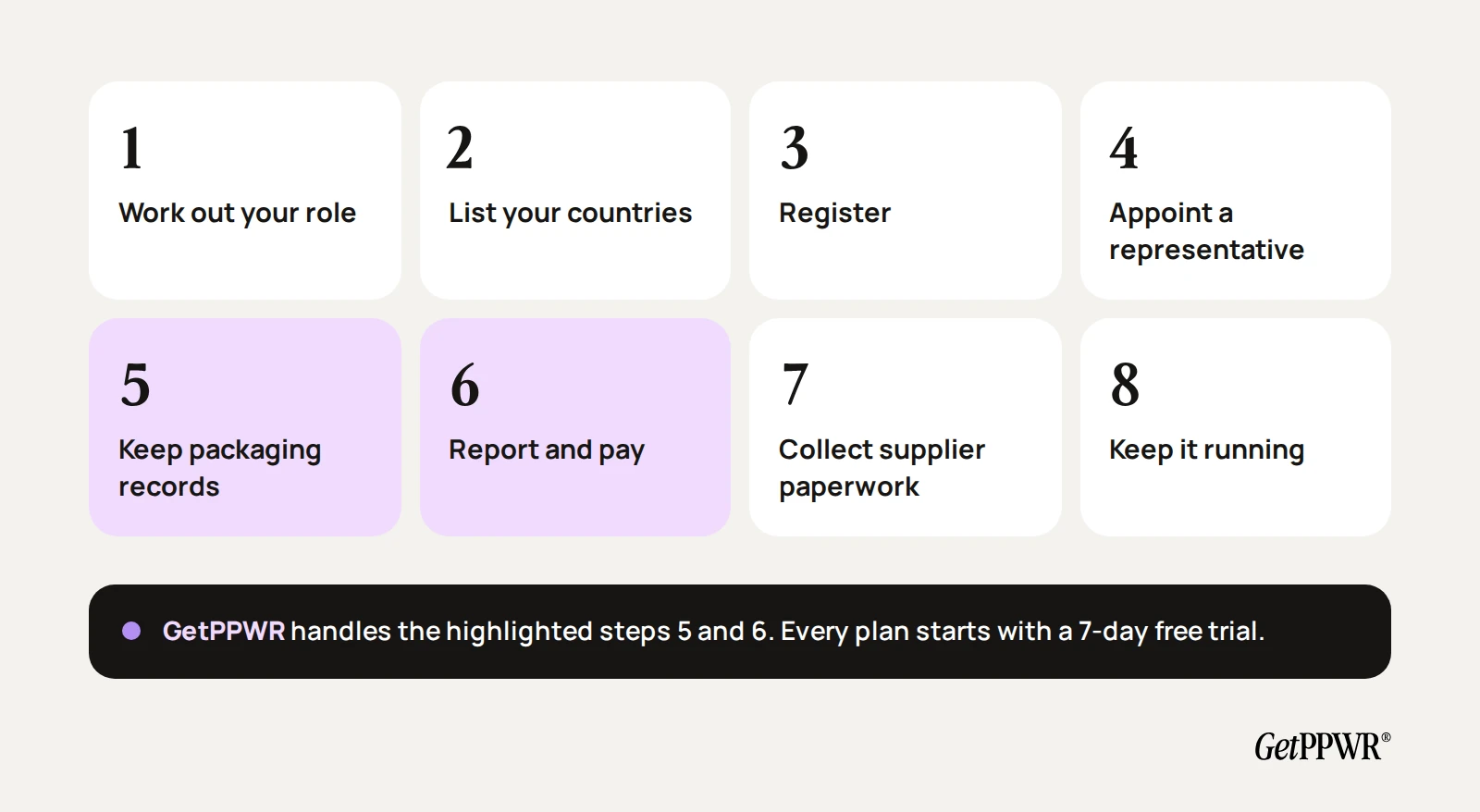
Steps 5 and 6 are what GetPPWR does. You set up your packaging once with automations, it applies it to every Shopify order, catches up on orders you’ve already shipped, and writes each country’s report in the format it wants. Your representative files it, and we work with Lizenzero for that. That covers all 27 EU countries you ship to, plus your home country’s EPR report, the producer responsibility report. Mark the shipping packaging you buy from a supplier in your own country, and GetPPWR leaves it out of your home EPR report, because that supplier is its producer there. Product packaging you fill yourself stays in, wherever you bought it. Every plan starts with a 7-day free trial.
Not sure which steps apply to you? Take the 2-minute quiz.
Sources: Regulation (EU) 2025/40, Articles 44 and 45; the European Commission’s PPWR FAQ.
Quick answers about PPWR for Shopify stores
Does Shopify handle PPWR for me?
No. Shopify doesn’t register you, report your packaging or pay your fees. As the seller, that’s on you.
I only sell in my own country. Does PPWR still apply?
Yes. Your own country’s register and reporting apply, and if you import products into the EU, you’re the producer of that packaging.
My Shopify store is in the UK. Do I need to do this?
Yes, for every EU country you ship to, through a local representative in each.
Does the shipping box count?
Yes. Mailers, boxes, fill and tape are packaging, and they go into your reports like everything else.